ADAPT / AI orchestration platform

The problem is not prediction.
It is control.

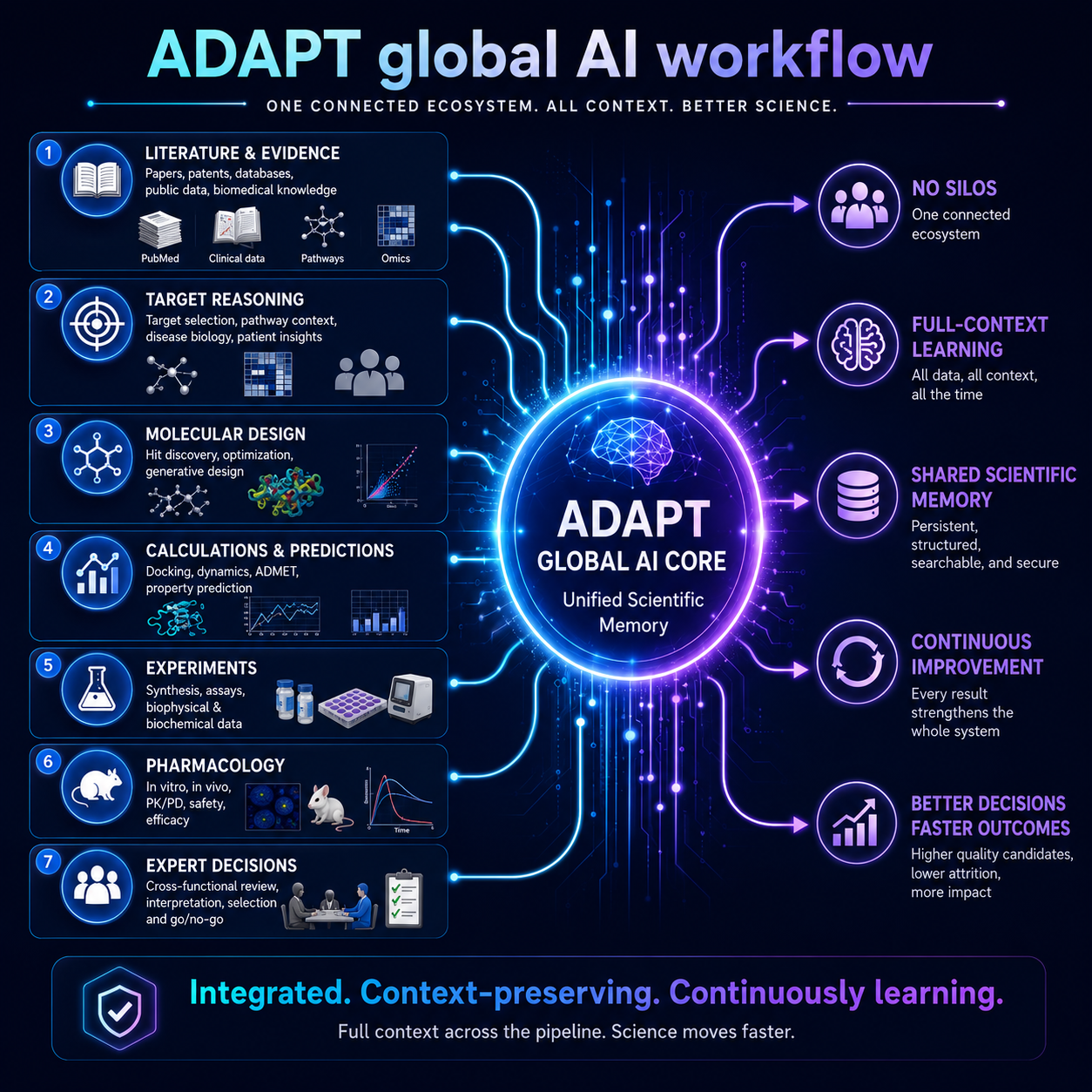
ADAPT treats drug discovery as a persistent, constrained inference process. Evidence, target hypotheses, molecular models, uncertainty and experimental outcomes remain connected so that each calculation changes the next decision—not just the next score.

ADAPT integrated computational drug-discovery workflow
Programme-level reasoningEvidence → biological frame → molecular models → multi-objective selection → physical experiment
5persistent scientific states
7+disclosed specialised modules
Stprogramme state, not a one-shot score
Δevery result must change a decision

01 / Why discovery stalls

Attrition often begins before the first molecule is scored

The common failure is decomposition: biology, literature, structure, chemistry, safety and experiments are optimised in separate systems. ADAPT keeps them inside one programme state and makes disagreement explicit.

01

The target is reduced to a protein name

Disease phenotypes are network phenomena. A tractable pocket can still be the wrong intervention if compensation, regulatory context and transcriptional response are ignored.
SCIENTIFIC REFERENCE: [A1] CLR-based gene-regulatory-network inference and transcriptional drug effects.

02

Evidence is fragmented into incompatible silos

Literature, structures, omics, assays and internal decisions are often stored with different identifiers and unequal provenance. The result is repeated rediscovery and unauditable rationale.
SCIENTIFIC REFERENCE: [A2].

03

A static structure becomes a false physical certainty

Binding sites move, hydration changes and induced fit matters. A single receptor snapshot can convert a conformational problem into an apparently precise ranking error.
SCIENTIFIC REFERENCES: [A3] receptor flexibility by MD/morphing; [A4] biologically informed docking.

04

Missing data are converted into confidence

Unmeasured endpoints, narrow applicability domains and split-dependent metrics cannot be repaired by model complexity. ADAPT preserves uncertainty as a decision variable instead of silently converting it into rank.
SCIENTIFIC REFERENCE: [A5] explainable toxicity prediction, applicability domain and qRASAR.

05

The membrane is treated as passive background

Classical target-centric discovery usually models the membrane as an environment around the target. The founders' scientific work shows the opposite: lipid composition, heterogeneity, packing, hydration, lateral pressure and phase propensity can regulate protein activity, stress signalling and phenotype. In membrane-driven programmes, the membrane physical state therefore becomes an intervention variable and a target class in its own right—not merely a correction to docking.
SCIENTIFIC REFERENCES: [A13] lipid composition and membrane activity; [A14] membrane sensor hypothesis and membrane lipid therapy; [A15] selective membrane remodelling; [A16] lipid-controlled G-protein organisation.

02 / The orchestration principle

ADAPT does not ask which model wins. It asks what the programme must know next.

GROUND

Evidence state

Claims are stored with source, scope, dissent and confidence rather than flattened into a summary.

FRAME

Biological state

The intervention is represented as a falsifiable mechanism inside a disease and regulatory context. The hypothesis space is not restricted to a protein node: it can include network states, membrane physical state and membrane-driven signalling when the biology requires it.

MODEL

Molecular state

Dynamic pockets, molecular similarity, docking, quantum descriptors and endpoint models contribute complementary evidence.

SELECT

Decision state

Activity, selectivity, ADMET, novelty, synthesis, cost and evidence quality remain explicit competing objectives.

St = {Ht, Et, Xt, Yt, Ct}  →  St+1 = T(St,Rt,qt) ADAPT represents a programme as hypotheses (H), evidence and provenance (E), molecular representations (X), predictions/experiments (Y) and constraints (C). Every returned result (R), together with its quality state (q), transforms the persistent programme state rather than producing an isolated score.

03 / Disclosed technical layer

One scientific question per module. No duplicated roles.

The public layer states the scientific object, the mathematical operation and the decision returned to ADAPT. Production thresholds, trained weights, internal schemas, model versions and proprietary benchmarks are discussed separately.

GENOA / TARGET REASONING

Is the intervention correct at network level?

GENOA treats the drug as a perturbation of a gene-regulatory network rather than an isolated drug–target pair. The published CLR basis evaluates context-specific mutual-information significance.

zi=max[0,(Iij−μi)/σi]
sij=√(zi2+zj2)CLR standardises the mutual information Iij of a gene pair against each gene's background distribution; the two positive z-scores are then combined to identify unusually strong regulatory relationships.

SCIENTIFIC REFERENCE: [A1].

MEMBRANE PHYSICAL STATE / TARGET CLASS

What if the therapeutic variable is not a protein pocket?

The founders' membrane-state work establishes a second intervention logic. Lipid composition and supramolecular organisation regulate membrane protein function, stress sensing and signalling. ADAPT can therefore preserve a membrane-driven hypothesis as a first-class biological state, allowing candidate selection to ask whether a molecule should bind a protein, remodel a membrane, or alter the coupling between the two.

MPS → {packing, hydration, lateral pressure, domain state, non-lamellar propensity}
intervention ≠ protein binding onlyThe membrane physical state is treated as a coupled set of physical descriptors rather than as passive background. This expands the intervention space from protein binding alone to membrane remodelling and membrane–protein coupling.

SCIENTIFIC REFERENCES: [A13], [A14], [A15], [A16]. The exact ADAPT state representation and production decision rules are part of the protected implementation layer.

TRANSMEMBRANE SENSING / MEMBRANE-ACTIVE SPACE

Can sequence space report the physical state a membrane has adapted to?

Transmembrane proteomes can be treated as bioinformatic sensors of membrane physical state. The published alignment-free k-mer strategy compares transmembrane sequences, whole proteomes and antimicrobial-peptide sets; the resulting distances provide a route to reason about membrane adaptation, selectivity and toxicity without reducing the problem to a single receptor.

dk-mer(TMP, AMP) → membrane-state / selectivity descriptorAn alignment-free k-mer distance compares transmembrane-protein sequence space with membrane-active peptides. The distance can encode adaptation to membrane physical state and can be developed as a selectivity or toxicity descriptor.

SCIENTIFIC REFERENCES: [A11] transmembrane peptides as sensors of membrane physical state; [A12] quantitative activity-aware AMP data.

DEEPSAGE + VIZIT / EVIDENCE

What is supported, contradicted or still unknown?

Graph-linked literature is converted into traceable evidence rather than a free-text answer. Majority and minority evidence remain distinguishable; graph relations retain source provenance.

J(A,B)=|A∩B| / |A∪B|Jaccard similarity measures the overlap between two evidence sets relative to their union. In an evidence graph it provides a simple, interpretable way to quantify shared context between biomedical entities.

SCIENTIFIC REFERENCES: [A6], [A2]. Platform-specific DeepSage/Vizit implementation is disclosed separately.

MATISSE / DYNAMIC POCKETS

Are two binding sites still similar when water and motion are allowed to speak?

MATISSE is solvent-centric. Water samples the binding cavity during short MD; retained oxygen positions define local spheres and a dynamic volumetric pocket descriptor.

ri=mina∈surface ||oi−a||2
p=(V,σV,ViVi,Ve),   d=||p−p′||2Each retained water oxygen defines a local sphere whose radius is its minimum distance from the pocket surface. Volumetric statistics are assembled into a descriptor vector p, and pocket similarity is evaluated as a distance between those vectors.

SCIENTIFIC REFERENCES: [A7], [A3].

SIMILIS / MOLECULAR DISTANCE

Can similarity remain atomistic without scaffold alignment?

SIMILIS maps 3D coordinates into a spherical reference representation while retaining atom-level charge, mass and reactivity weights. The comparison is designed to avoid dependence on a predefined scaffold alignment.

φ=atan2(y,x)    ψ=acos(z/r)Cartesian atomic coordinates are converted into spherical angles before topology and physicochemical weights are added. This removes dependence on a chosen molecular orientation while preserving atom-level information.

SCIENTIFIC REFERENCES: [A7], [A8].

BATTLESHIP / HIERARCHICAL SCREENING

Why dock millions of molecules if the library has structure?

Libraries are partitioned into structurally coherent regions. Representatives are physically docked; a learned surrogate propagates the expensive calculation to the remaining chemical space, with cluster diagnostics retained.

rk=arg minx∈Ck Σy∈Ckd(x,y)
ŷ=fRF2D3D)The first expression selects a representative medoid for cluster Ck. Docking is performed on representatives; a Random Forest surrogate then predicts scores for undocked compounds from 2D/3D descriptors.

SCIENTIFIC REFERENCES: [A4], [A9].

XAI + ADMET / TRUST BOUNDARY

When is a prediction allowed to influence selection?

Endpoint predictions are retained with applicability domain, calibration state and interpretability. Out-of-domain predictions and missing endpoints remain uncertainty; they are not silently converted into negative evidence.

0.841
best reported KidneyTox accuracy; explicitly split-dependent

SCIENTIFIC REFERENCES: [A5], [A10].

PARETO / MULTI-OBJECTIVE SELECTION

Which candidates remain defensible when objectives conflict?

Activity, selectivity, ADMET, synthesizability, novelty and cost are not collapsed into an undocumented scalar. Candidate selection is explicitly vector-valued.

f(x)=[fact,fsel,fADMET,fsyn,fnov,fcost]
x≺y ⇔ ∀k fk(x)≤fk(y) ∧ ∃k fk(x)<fk(y)Each molecule is evaluated as a vector of competing objectives. A candidate dominates another only when it is no worse on every objective and strictly better on at least one, exposing trade-offs instead of hiding them in a single score.

SCIENTIFIC REFERENCE: [A2].

PROTECTED MODULES / TECHNICAL DISCLOSURE

The public page is intentionally incomplete

Additional specialised modules, internal objective scaling, production model selection, thresholds, graph schemas, versioned datasets and programme-specific acquisition functions are discussed under technical disclosure. The boundary is deliberate: the scientific object is public; the implementation advantage is not.
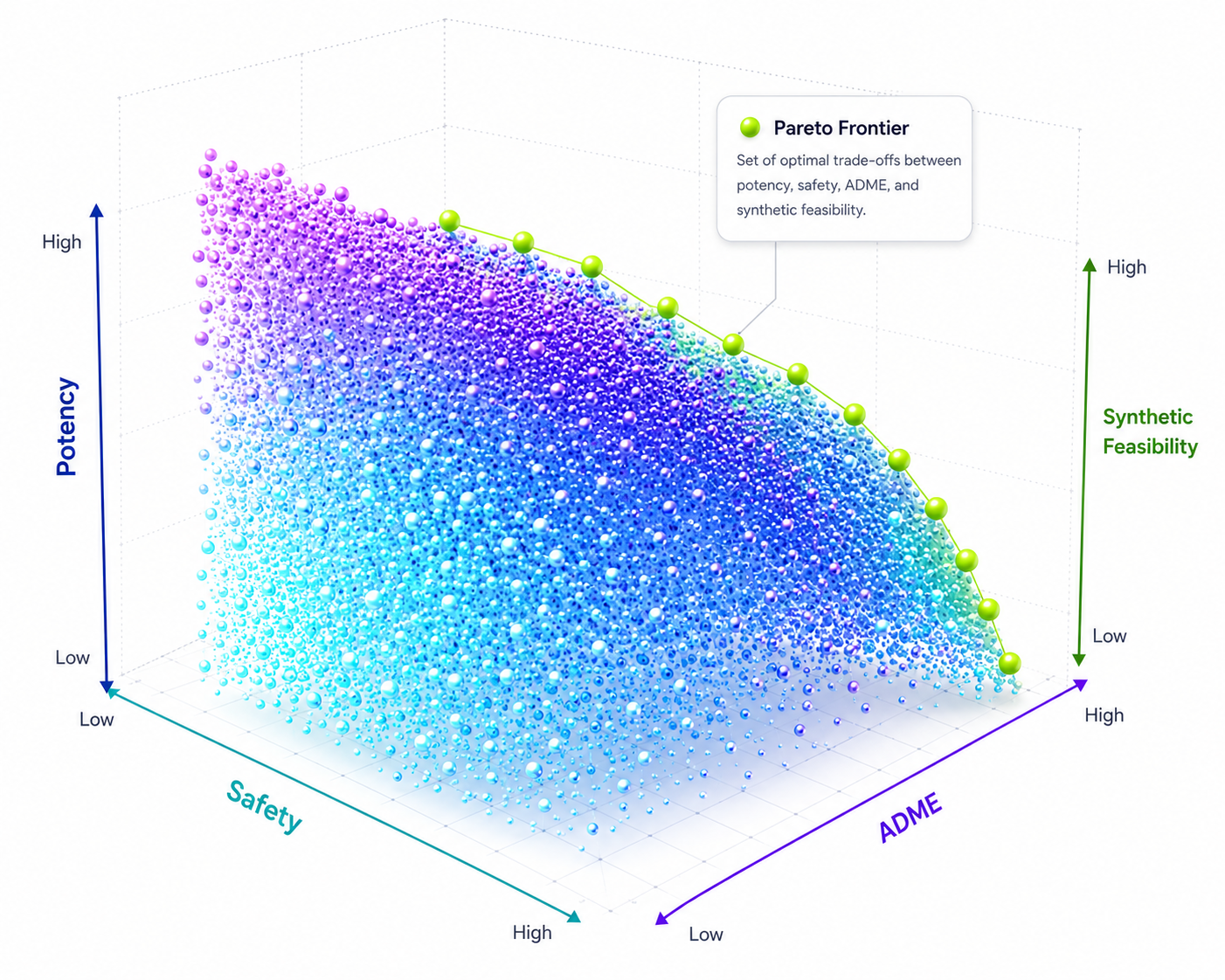
Pareto frontier for multi-objective molecular optimisation
Multi-objective selection should expose the trade-off surfaceThe Pareto frontier makes potency, safety, ADME and synthetic feasibility simultaneously visible instead of hiding them inside a single composite score.

04 / Where the orchestration becomes decisive

The output is not a ranking. It is the next informative experiment.

ADAPT chooses what should be made and measured under the current biological, chemical, safety, cost and evidence constraints. SYNTHEX supplies the physical feasibility boundary and returns qualified outcomes—including failures.

A candidate is useful only if the experiment can discriminate between competing hypotheses.

This is the point at which isolated models stop behaving like software tools and start behaving like a discovery system.

Public acquisition abstraction

xt+1=arg maxx∈Ωfeasible IG(x)·U(x)Public abstraction: choose, among physically feasible experiments, the candidate expected to reduce programme-relevant uncertainty while retaining scientific and development value. The production acquisition function and weights are proprietary.

IG(x) — expected reduction of programme-relevant uncertainty.
U(x) — scientific and development value across the selected objectives.
Ωfeasible — synthesis, handling, analytical and assay constraints exposed by SYNTHEX.

05 / Evidence standard

Published components. Traceable programme logic.

The scientific genealogy spans membrane physical state and membrane lipid therapy, transmembrane sensing, network-level intervention, biologically informed docking, molecular dynamics, physically informed molecular descriptors, interpretable toxicity prediction, target-specific ML and integrated computational workflows. The value claim for ADAPT is the controlled orchestration of those capabilities around one persistent programme state.

TARGET CLASSES

The biology is not forced into a protein-pocket ontology

ADAPT can retain network-level and membrane-state hypotheses alongside conventional protein targets. This matters when the causal variable is a regulatory state, membrane organisation or lipid-controlled signalling rather than a single binding site.

[A13] MPS target · [A14] membrane lipid therapy · [A11] transmembrane sensing
METHODS

Physics and biology remain in the loop

Dynamic structures, chemical representations, network context and endpoint-specific models are treated as complementary evidence—not interchangeable scores.

[A4] Yada · [A3] MD/morphing · [A7] hKMO 4D-QSAR · [A10] DPP-4
INTERPRETABILITY

Uncertainty is operational

Applicability domains, explainability and missing endpoints determine whether a prediction is admissible for selection.

[A5] KidneyTox · [A7] hKMO · [A10] DPP-4
ORCHESTRATION

The programme remembers

Decisions, failures and contradictory evidence remain reusable in the next cycle rather than disappearing into isolated reports.

[A2] Integrated computational workflow → prospective physical closed loop

06 / Scientific references

The algorithms have a published genealogy.

Each marker used above points to a specific publication from founders scientific portfolio. These papers support the scientific principles and component methods; they do not, by themselves, disclose protected ADAPT production code, thresholds or unpublished benchmarks.

A1

Network-level target reasoning

Inference of Gene Regulatory Networks for Drug Repurposing: A CLR-Based Strategy to Predict Transcriptional Drug Effects. RExPO25 conference contribution (2025). DOI: 10.58647/REXPO.25000090.v1.

A2

Integrated computational drug discovery

Advancing Drug Discovery through Integrative Computational Models and AI Technologies. Drug Repurposing (2025). DOI: 10.58647/DRUGREPO.25.1.0001.

A3

Receptor dynamics and conformational docking

Molecular Dynamics and Morphing Protocols for High Accuracy Molecular Docking. In Advances in Bionanomaterials, pp. 85–96 (2018). DOI: 10.1007/978-3-319-62027-5_8.

A4

Biologically informed docking

Yada: A Novel Tool for Molecular Docking Calculations. Journal of Computer-Aided Molecular Design 30, 753–759 (2016). DOI: 10.1007/s10822-016-9953-9.

A5

Explainable ADMET and applicability domain

KidneyTox_v1.0: Explainable AI and Machine Learning for Nephrotoxicity Prediction. Scientific Reports 16, 5099 (2026). DOI: 10.1038/s41598-026-35496-4.

A6

AI and knowledge-driven repurposing

Machine Learning in Drug Repurposing. In Machine Learning and Deep Learning in Drug Design, RSC (2026). DOI: 10.1039/9781837070206-00490.

A7

4D-QSAR, chemical space and XAI

First 4D-QSAR Study of hKMO Inhibitors: Integrating Chemical Space Networks and an Explainable AI Platform. ACS Omega 10, 39751–39762 (2025). DOI: 10.1021/acsomega.5c03404.

A8

Ligand + structure-based target modelling

PPAR-gamma Modulator Predictor: Integrating Chemical Space Networks, Molecular Docking and Machine Learning. Molecular Diversity 29, 3305–3321 (2025). DOI: 10.1007/s11030-025-11118-5.

A9

Scaffold and activity-landscape reasoning

A Battleship between Hydroxamates versus Non-Hydroxamates in HDAC3 Inhibition. Journal of Molecular Graphics and Modelling 142, 109199 (2026). DOI: 10.1016/j.jmgm.2025.109199.

A10

Complementary molecular representations

AI/ML-Driven DPP-4 Inhibitor Predictor (d4p_v1). Archiv der Pharmazie 358, 70106 (2025). DOI: 10.1002/ardp.70106.

A11

Transmembrane proteomes as sensors of membrane physical state

Transmembrane Peptides as Sensors of the Membrane Physical State. Frontiers in Physics 6:48 (2018). DOI: 10.3389/fphy.2018.00048.

A12

Quantitative antimicrobial-peptide data

YADAMP: Yet Another Database of Antimicrobial Peptides. International Journal of Antimicrobial Agents 39, 346–351 (2012). DOI: 10.1016/j.ijantimicag.2011.12.003.

A13

Membrane physical state as a pharmacological variable

The Significance of Lipid Composition for Membrane Activity: New Concepts and Ways of Assessing Function. Progress in Lipid Research 44, 303–344 (2005). DOI: 10.1016/j.plipres.2005.08.001.

A14

Membrane sensing and membrane lipid therapy

Plasma Membranes as Heat Stress Sensors: From Lipid-Controlled Molecular Switches to Therapeutic Applications. BBA — Biomembranes 1838, 1594–1618 (2014). DOI: 10.1016/j.bbamem.2013.12.015.

A15

Molecular rules for selective membrane remodelling

The Effect of Hydroxylated Fatty Acid-Containing Phospholipids in the Remodeling of Lipid Membranes. BBA — Biomembranes 1838, 1509–1517 (2014). DOI: 10.1016/j.bbamem.2014.01.014.

A16

Lipid-controlled membrane organisation and signalling

G Protein-Membrane Interactions II: Effect of G Protein-Linked Lipids on Membrane Structure and G Protein-Membrane Interactions. BBA — Biomembranes (2017). DOI: 10.1016/j.bbamem.2017.04.005.