03 / Execution subsystem specifications
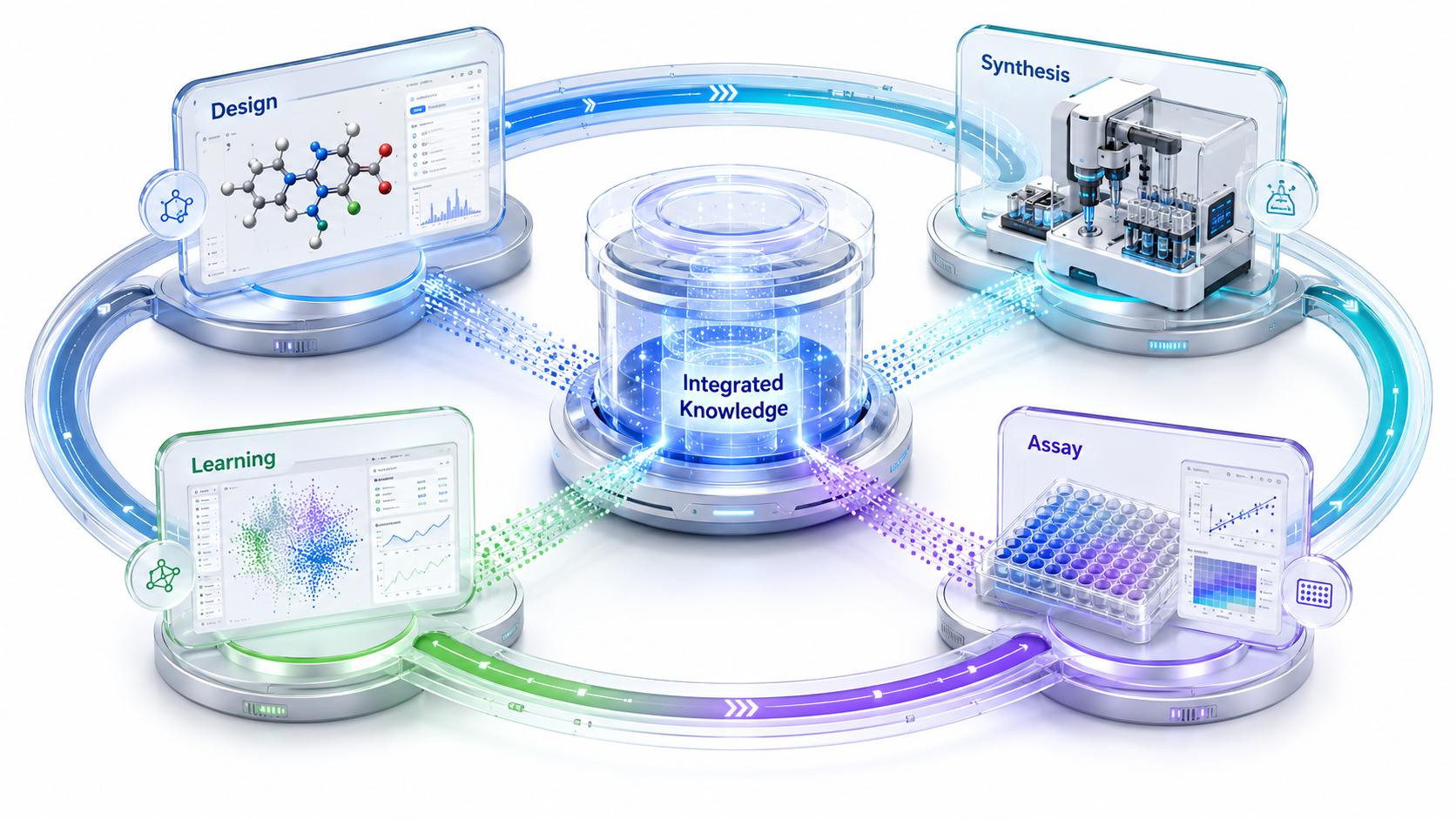
Five coupled subsystems. One role each.
SYNTHEX is not generic laboratory automation. Its architecture is built around miniaturised chemistry: inexpensive parallel execution, recoverable material handling, AI-assisted mixture-state inference, qualification and data return remain coupled throughout the synthesis.
CUSTOM ROBOTIC EXECUTIONTranslate a digital batch into reproducible operations
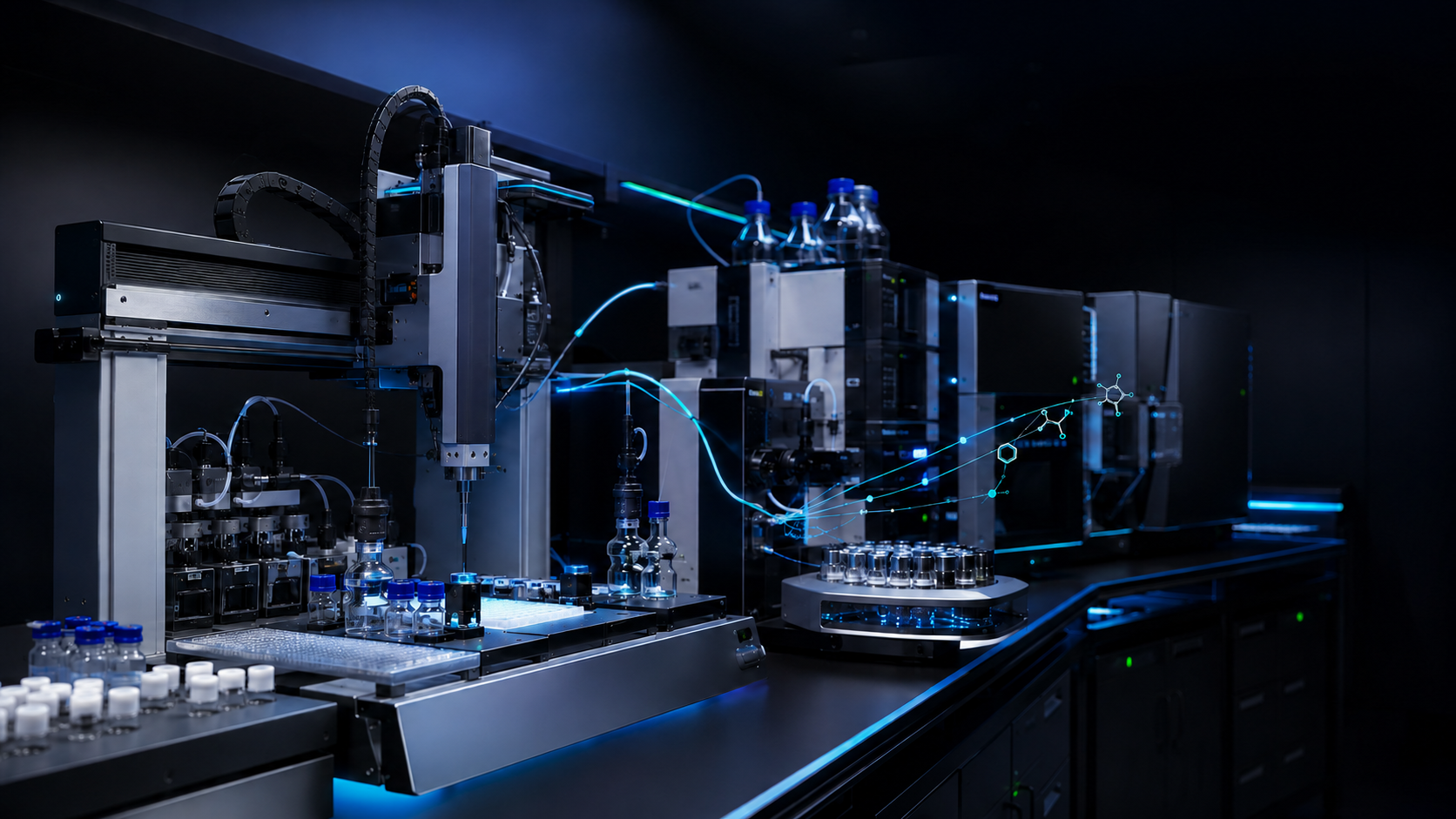
Programme-specific modules execute miniaturised liquid handling, timed reactions, transfers and instrument hand-offs with position-level timestamps, deviations and alarms. Small payloads and reagent volumes reduce hardware demands, supporting lower-cost robots that can be replicated for high parallelism.
Input object
route graph · reagents · volumes · conditions · controls · position map
ENGINEERING LINEAGE: [S5]. This supports instrumented experimental-process optimisation, not SYNTHEX robotic hardware performance.
FUNCTIONALISED MAGNETIC SUPPORTSMake separation part of the reaction architecture
Recoverable magnetic supports provide a physical handle for immobilisation, sequential reaction, washing, separation and release at miniaturised scale.
Fm≈(VpΔχ/μ0)(B·∇)BMagnetic capture scales with particle volume Vp, susceptibility contrast Δχ and, critically, the spatial gradient of the field B. A strong but uniform field is not enough: the gradient is what drives the support toward the capture region.
MATERIALS REFERENCES: [S2], [S3]. These document solid/material synthesis and characterisation; the supplied bibliography does not directly validate the magnetic-support subsystem.
MINIATURISED PARALLEL SYNTHESISIncrease experimental diversity without scaling reagent consumption
SYNTHEX increases reaction density by shrinking the amount used per experiment. The advantage is simultaneous: faster preparation, higher parallelism, lower reagent cost and lower waste/exposure. Throughput is counted as qualified products—not crude reaction attempts—so speed cannot hide poor chemistry.
TP=Nqualified products/Tcycle
Y=nqualified product/nlimiting reagentTP measures useful throughput as the number of identity/purity-qualified products delivered per cycle. Y is the chemical yield relative to the limiting reagent. Keeping the two separate prevents high reaction count from being mistaken for productive synthesis.
EXPERIMENTAL REFERENCE: [S1].
GENETIC ALGORITHM / MIXTURE-STATE TRACKINGFollow the mixture when conventional purification no longer scales
Miniaturisation makes repeated isolation and purification difficult because every transfer consumes material and time. A proprietary genetic-algorithm tool therefore tracks the evolving composition of the reaction mixture along the synthesis trajectory, allowing SYNTHEX to reason about a dynamic mixture instead of assuming a perfectly purified intermediate after every step.
ct=(c1,t,…,cn,t), Σici,t=1
fitness(ct) ∝ agreement(observationt, predicted-mixture(ct))Public abstraction: each candidate chromosome represents an admissible mixture composition at synthesis step t. Selection, crossover and mutation search for the composition most consistent with the available process observations. The exact encoding, fitness function and analytical interface are proprietary.
PROPRIETARY SYNTHEX MODULE: this capability is supplied from the founders' internal technology stack; no peer-reviewed methods reference for the specific implementation was provided in the current bibliography.
ANALYTICAL + BIOLOGICAL VALIDATIONSeparate material quality from biological truth
A biological measurement is admitted into the learning loop only after chemical identity and purity are qualified and assay controls establish that the measurement itself is interpretable.
Z′=1−3(σp+σn)/|μp−μn|The Z′ factor compares the separation of positive and negative controls with their variability. High separation and low variance produce a larger Z′, indicating that the assay can meaningfully distinguish biological signal from experimental noise.
VALIDATION REFERENCES: [S4], [S6].